HAM licensing school errors

Here is an ad for a school offering a HAM license.

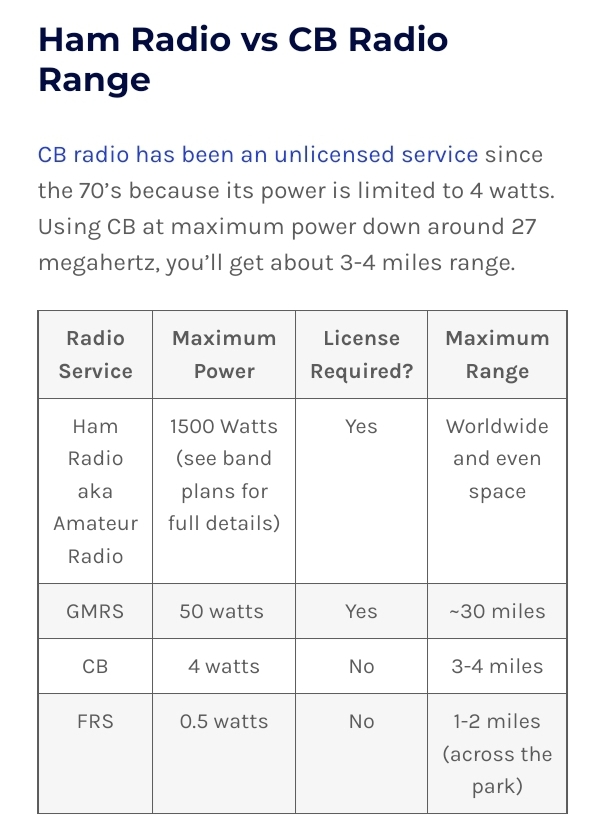
It says the wattage for 11 meters in 1947 was 5 watts internally and 4 watts at the antenna.

It also says the range for Citizens Band Radio is 20 to 30 miles from a base station to a 102-inch antenna.

The first time I ever saw a Citizens Band Radio was from Clovis, California, to Grapevine, California—about 160 miles.

In 1962 or 1963, I used a walkie-talkie from Clovis, California, to Mendota, California—about 50 miles—while standing under a Yagi antenna pointing toward Mendota.

Seeing a misleading ad for HAM licensing sounds like a Rubber Ducky at work. I cut off the name to protect the guilty.

Dave

PS I have been doing skipping last week over 2,000 miles on just a 4 watt Handheld CB Cobra HH50WXST

Dave I agree with that old specification. You constantly insist your own experiences are correct and Government ones are wrong. You misunderstand the physics so badly that it is difficult to know when to correct you. Skip is a non-guaranteed propagation process. It cannot be guaranteed, and is a phenomenon that comes and goes depending on the atmospheric condition. Let me also put a few things right. All the bands and services you mention are capable of reception in space, IF there is something up there that can receive it. Radio hams have satellites, and sometimes astronauts. Brazilian truck drivers use UHF radios to talk to each other on US owned satellites that your Government did not bother to switch off when they stopped using them. An astronaut with a GMRS radio would be able to talk to thousands of people with just a few Watts. Your favourite CB has almost the same capability as a radio ham’s 10m TYT mobile in their car. Sometimes a different continent, sometimes just a few miles. The reason your Government chose UHF low power for GMRS was to limit the range, but under the right circumstances, they too might be able to go a very long way. There is a condition known as tropospheric ducting (you can google it) and under some conditions a reflective pathway is created, usually over water, and if your signal gets into it, it pops out the other end! I live on the UK’s east coast, and the west coast of Holland can be in some months covered by these conditions, and I have spoken from our beach to a Dutch ham also on a handheld for about half an hour until the duct closed. It would be silly to say that uhf 1 Watt hand held radios can transmit up to 120 miles to another! The other thing is the constant banging on about certain length CB antennas. CB antennas for cars MUST be shorter than they should be. A1/4 wave on a car is impossible, so coils are used at the base in some designs and higher up the whip on others, like the very elderly DV27 designs vs the K40 designs of the pioneering days. All that changes is angle of maximum radiation, and transfer of transmitter power into effective radiated power. Different designs work differently, but NONE are magic. Once you get to VHF and UHF, base station antennas get much more efficient, and instead of omni directional can become beams, producing serious amounts of gain in certain directions. What then matters is path loss. The way the power gets to the final direction. Some will be absorbed or reflected by ‘things’. People, mountains, buildings, forests etc etc. the initial power will become weaker and weaker, but if enough is left at the far end, a similar setup that end can produce a solid link, all the time, independent from weather, temperature and atmospheric conditions. Keep in mind that frequency effects exist too. Lower frequencies tend to follow the earth and the distance changes during the day/night. In the U.K., the BBC just closed down a network on 198KHz. People are amazed that without the huge BBC transmitters, they are now hearing new stations on the frequency from huge distances. Go up in frequency and the ground hugging effect stops. Once you get to VHF, the propagation mode is essentially line of sight reliably, so the horizon is the key. Antenna height increases this distance. That signal wont go past the horizon, but will go out into space, as do virtually all radio waves, unless reflected back by the ionosphere. The physics does not need labels or countries or published laws, just one. The laws of physics. These are the key feature of radio. A balance of power, frequency and natural conditions.

The lower frequencies are better for longer-distance communication.
I am getting thd same operators on daily bases.
Only today able to get spots inside California.
It only time before myself and or others get 11-meter to work on skip communication.
Today HAM operators are not interested in 11-meter skipping I may be wrong on this part .
⸻⸻⸻⸻
Back to real subject ads
I do not like ad that lies to sell something. My first experience in Citizens Band radio was in 1961 only 3 yeear after Class D was formed and some many ads giving false informational to sell services or products.
You see this school trying to say Citizens Band is only 2 miles they used Citizens Band for Taxi’s and service trucks in the 1960’s 20 to 30 miles from base station to truck or taxi. They used most time a J-Pole antenna for base station and 102 inch on the taxi or truck. I do not read that i saw what used and. Told us the range of there equipment.

It like wattage for setup for 10k spacing in 1947. But manufacturer buy new 4 watt radio . Only thing change was where the FCC hade the Manufacturers check wattage to antenna side . In 1947 the rule was. 5 watt internal and 4 watt after antenna but then the manufacturer wass require to check internal but 1970’s the FCC change to antenna side see FCC.gov for more data

Dave

You are sort of basing your conclusions on temporary results Dave. Hams are not involved in 11m skip, because they use 11m. BUT - you have to remember that best distance at any time is based on the science - so if there is no skip on 10m, their licence allows them to go lower in frequency - maybe to 20m, where that band might be open. many hams use prediction software that takes in data from all over the world and tells them what bands are open (as in propagation is good) and which bands are closed. If a band is closed, then it’s local signals only. You can chat regularly to somebody a long way away, up until the time things change - and then if the band is dead, your longer distance contact is gone.

You are really hung up on the local distance thing. This is set by height above ground in virtually every case. The question is what I mentioned - path loss. Is there a path between location 1 and location 2? You often mention portable CB - this has been really variable ever since they started to make them. The antennas are terrible - the transmitter is designed to accept very poor VSWR, but usually something gets out. If that something is good enough - all is well. A car to a base station will not have the same perfomance as a huge truck with wing mirror mount antenna to the base - because it is higher, less restricted by obstacles.

It is IMPOSSIBLE for anyone to say 4 Watts is X miles. RF dos not work like that. Just because you get 30 miles does not mean somebody else will. Received signal strength is the deciding factor - but things in between reduce signal. You could go to a perfectly flat area and wherever two stations set up, the best distance would be similar. The minute you add hills, or even different types of ground conditions it changes. You mentioned that only today you can get spots within California - well, something changed, didn’t it? Not the laws of physics.

You even have to be careful. An 8m J-pole for CB frequencies is huge, but sellers play games with the gain figures. One claims 5dB gain - but says compared to a dipole - gain figs compared to dipoles should always say dBd - but this doesn’t so probably is 5dBi - but a dipole is almost 3dBi so the little bit of extra gain over a dipole is stated a bit craftily, forgetting to join the two together in maths. So the J-pole might have 2dB difference from the dipole, and 2dB is only just detectable practically. They just play with numbers to make them sound better than they are. What is certain is the J-Pole has more gain than the 102 inch truck antenna. 102" being very close to a quarter wave. That quarter wave also relies on having a good ground plane - which on a truck or taxi you do not have.

In all your posts, you try to make hard and fast rules, but then generalise, and use your own experience to bolster up the mangled rules you’ve sort of produced. I’m old enough to remember Skippy on TV and at that time radio hams were laughing at their huge hand held radios that could work over vast distances when people were in trouble. Nothing has changed. Low power, poor antennas and distance are unreliable as a tool.

Last thing - the old regulations all over the world took into account feeder loss - squirt 10W down a bit of poor cable so there was only 4W at the antenna was one way to describe power rules, but now with much more handheld radio use, it’s more sensible to always just talk about power output at the socket. For me - power is pretty unimportant, but antennas very much the vital element. Many years back, I wanted to talk to a friend 5 miles away and an American voice kept calling me. My local friend was weaker than the American voice, because he was in Skylab - a great example of a great path - absolutely line of sight between him over Africa to me in the UK. He had just 1W - all NASA allowed him to use. Power is just not that vital. In fact many radio hams deliberately use very low power and can still talk around the world.
It is a Taxi :oncoming_taxi: cab aka car.
It is van size or pickup ½ to 1 ton size

That’s fine, but even a big van is not large enough to be a good ground plane - After all, a quarter wave would be at least 10ft from the centre of the roof? It will tune, but it’s less than a good antenna. Dont think this makes it a bad antenna, just a normal mobile antenna - but not as good as a full size resonant one.

The j-pole antenna on top of buildings was about 20 foot tall in 1960’s. The only real drawback to 11-meter was size of antenna nèed for a 20 or 30 miles range.
A walkie-talkie with antenna the manufacturer put on the walkie-talkies was short range. You yell as someone if CB was out of range. This where a nice HAM operator told to add a waire to the antenna. It was amazing the difference

Still true today with rubber duck :duck: Antenna. When go my HH50WXST i purchase a 52 inch.
In my Tacoma i carry 35 feet wire if need a boss in range.

I do believe we will lot more CB with rule changes {distance& range}.

Dave

. ⁜⁜⁜⁜⁜⁜⁜⁜⁜⁜⁜⁜⁜⁜⁜⁜⁜⁜⁜⁜⁜⁜

I do believe this whole new aera for sales on improved radios and antennas in Citizens Band Radios.
Todat there are sale sale for backup communication the in Amateur Radio in Citizens Band {11-meters}

Dave

No one want use the low cost radios They want high quality radio and equipment with out the hassle of a license

The FCC didn’t really change anything - In England we have an old tale of King Canute - who believed he could order anything and it would obey him, until he put his throne on the beach and commanded the tide not to come in. It did! The FCC had a rule that the laws of physics made impossible. Since CB was introduced people just spoke to each other, with very few realising there even was a distance regulation - impossible to police, so eventually they just gave up.

In america you have this ‘prepper’ thing. We don’t do it here. Nobody has emergency radios (well apart from a few of the hams) Nobody has food supplies. The thing about emergency radio is that the success is linked to the skill of the operator. Low cost emergency radios are very popular, cheap enough people buy more than one for reliability. The thing with radios now is that faults are very rare. The expensive brands have more features, technical specifications are tighter, and they are better designed to operate more simply. Lifespan is good. I still have an Icom IC-32 hand-held I bought in the 80s - still a great well designed radio.With CB, there are not really very many features that can be added, that don’t already exist. Is SSB operation legal in the US? If so, that’s a much better mode for your liking of working foreign countries, or all of your own one? AM and FM are just not so good with distance.

The number in America buy a CB back is largest number . Most buy for big box stores. Is far greater than trucking industry at 5.3 million.
The channel is usebin my county only in the mountains where commercial is spody. The reports are it usev24 times a year.

Dave